Process Diagram Masterclass
Describe sequential stages using passive voice, sequencing language and purpose clauses — with total confidence and zero confusion.
What Is a Process Diagram Question?
A Process Diagram shows a sequence of stages or steps — how something is made, how a natural cycle works, or how a manufacturing/recycling process unfolds. Unlike other Task 1 types, there are no numbers to report. Your entire focus is on describing what happens at each stage, in the correct order, using appropriate vocabulary and grammar.
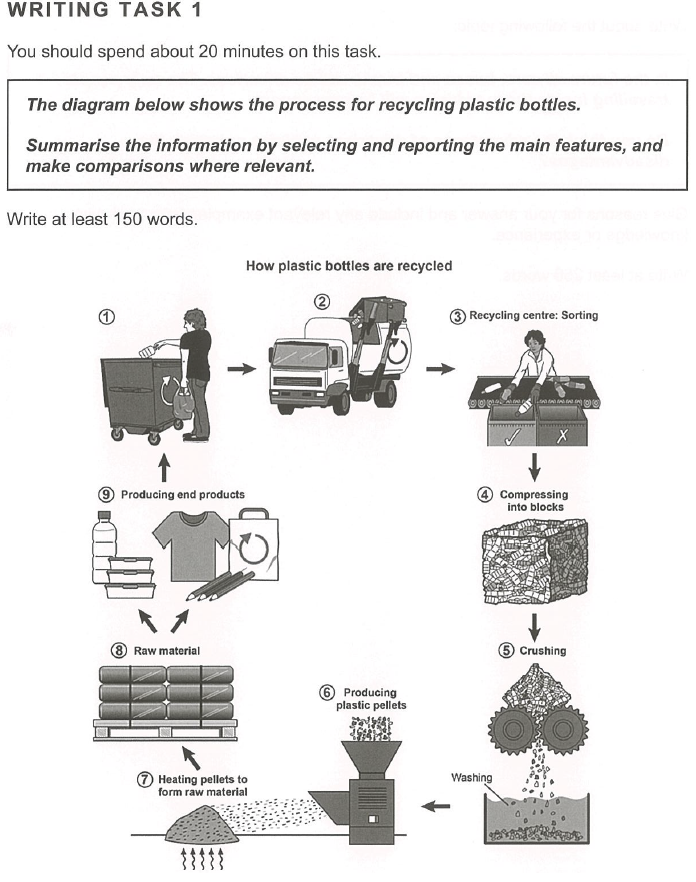
Study the prompt carefully before writing. Identify the key variables, time periods, and units.
Plan First — Always
⏱ Use the First 2–3 Minutes to Plan
Before typing a single word of your essay, spend 2–3 minutes identifying: the main trend(s), any notable exceptions or comparisons, and how you will group your detail paragraphs. Students who plan first consistently write more cohesive, Band 7+ responses. Jumping straight into writing is one of the most common mistakes test-takers make.
📋 The 4 Official Marking Criteria — Equal Weighting
Every Task 1 answer is marked on exactly four criteria, each worth 25% of your Task 1 score:
1. Task Achievement — Did you address the task? Is there a clear overview? Did you select and highlight key features?
2. Coherence and Cohesion — Is the essay logically organised? Does it progress clearly? Are cohesive devices used appropriately, without over-use?
3. Lexical Resource — Is vocabulary varied and precise? Are less common words used appropriately?
4. Grammatical Range and Accuracy — Are a variety of structures used? Are sentences mostly error-free?
The overview directly impacts Criterion 1. Vocabulary variety directly impacts Criterion 3. Sentence variety impacts Criterion 4. All four are equally important.
The 4-Paragraph Formula
Why Always 4 Paragraphs?
A clear 4-paragraph structure instantly signals to the examiner that you are organised and aware of what Task 1 requires. It separates general from specific, ensures you never mix raw data into your overview, and makes your essay easy to read and mark. Stick to this every single time.
1 Paragraph 1 — Introduction INTRO
Paraphrase: "diagram" → "diagram/illustration", "shows" → "illustrates/depicts/outlines", "the process for recycling" → "the series of stages involved in the recycling of / how [material] is recycled". Add a start and end reference for richness.
Paraphrase: The diagram illustrates the series of stages involved in the recycling of plastic bottles, from initial disposal to the manufacture of new products.
2 Paragraph 2 — Overview OVERVIEW ★
The Overview — How Many Stages? What's the Journey?
Start with Overall,. State the total number of stages, the starting point, the end point, and optionally the two or three key mid-point processes. Do NOT describe any individual stage in detail here.
3 Paragraph 3 — Detail Group 1 DETAILS
Cover the first half of the process — stages 1 to 5: disposal → collection → sorting → compressing → crushing and washing. Use passive voice throughout and clear sequencing adverbs to connect each stage.
4 Paragraph 4 — Detail Group 2 DETAILS
Cover the second half — stages 6 to 9: pellet production → heating → raw material → end products. Use "Following this" or "Having been washed" to connect smoothly from paragraph 3. End with the final product and, if natural, note that the process creates a complete cycle.
How to Build Your Sentences
Mix All Three Types Naturally
IELTS examiners reward grammatical range. The key word is natural. Only use linking words and complex structures when they genuinely improve clarity, never just to sound academic.
Passive Voice — The Gold Standard for Processes
Process diagrams describe what happens to something, not what a person actively does. Use passive voice to keep the focus on the material, not the actor.
Sequencing Sentences — Connecting Stages
Use sequencing adverbs and conjunctions to show the flow from one stage to the next. These are essential for process writing.
Complex Sentence — Purpose Clauses
Use "in order to" or infinitive of purpose to explain why a stage happens, adding analytical depth.
Relative Clauses — Avoiding Repetition
Use relative clauses to connect two related actions without starting a new sentence.
Strategies Specific to This Question Type
🔄 No Data — Just Stages
Process diagrams contain no numbers, percentages, or time periods. There is nothing to quantify. Instead, your job is to: (1) identify how many stages there are, (2) describe what happens at each stage using precise language, (3) show clear sequencing from start to finish.
⭐ The Overview for a Process
Your overview should state: how many stages the process has, what the starting point is, and what the end result is. This gives the examiner a "map" of the whole process before you go into detail.
📦 Group Stages Logically for Detail Paragraphs
Divide the 9 stages into two logical groups. A natural split for this diagram is: Collection & Preparation (stages 1–5: disposal → truck → sorting → compressing → crushing/washing) and Transformation & Production (stages 6–9: pellets → heating → raw material → end products).
🚫 Avoid Agent-Heavy Language
Do not write "workers crush the plastic" or "the machine makes pellets". Use passive or impersonal structures: "the plastic is crushed", "the pellets are produced in a machine". This is the academic register that IELTS rewards.
Pro Tips That Separate Band 7 from Band 6
Proofread After Each Sentence
Don't wait until the end to proofread. Read each sentence immediately after writing it. If you spot errors at the end with only 30 seconds left, you will panic and that leads to more mistakes. Sentence-by-sentence proofreading keeps you calm and accurate.
Keep Your Overview Data-Free
The overview covers main trends, differences or stages. Never include specific numbers, percentages, or dates here. Save all raw data for your detail paragraphs. This is the single most common mistake that costs students marks on Task Achievement.
Group Details Logically
Don't just describe each category one by one. Group the highest with the lowest to show contrast, OR the highest with the second-highest if they're close together. Logical grouping shows analytical thinking, which is exactly what examiners reward.
Paraphrase — Don't Copy
Your introduction must paraphrase the task prompt using strong synonyms where appropriate. But don't force synonyms — only replace words when a genuinely better alternative exists. Forced vocabulary sounds unnatural and lowers your Lexical Resource score.
Do Not Over-Use Linking Words
The official IELTS criteria explicitly penalises both under-use and over-use of cohesive devices. Do not start every sentence with "Furthermore", "Moreover" or "In addition". Use linking words only when they add logical meaning. Two or three well-placed connectors per paragraph is enough. Forcing them into every sentence reads as mechanical, not fluent.
Aim for 175–200 Words
The official minimum is 150 words. Going under directly reduces your Task Achievement score. The sweet spot is 170–190 words. Going much over 200 wastes your 20 minutes and risks introducing errors. Every sentence must add genuine information value. Padding to reach a word count is penalised under Task Achievement.
Circular vs Linear Processes
Check whether the process is linear (has a clear start and end) or circular (loops back to the beginning). This recycling process is essentially circular — the "end products" could become new bottles that enter the recycling process again. Mention this in your conclusion sentence if space allows.
Full Model Answer — Annotated
Model Answer with Paragraph Labels
The diagram illustrates the series of stages involved in the recycling of plastic bottles, from initial disposal to the manufacture of new products.
Overall, the process consists of nine sequential stages, beginning with the collection of used plastic bottles and ending with the production of new items. The procedure involves sorting, compressing and crushing the waste material, followed by transformation into pellets and raw material before it is manufactured into final products.
At the first stage, consumers place used plastic bottles into designated recycling bins. These are then collected by a truck and transported to a recycling centre. Upon arrival, the bottles are sorted manually to remove unsuitable items. The selected bottles are subsequently compressed into large blocks to facilitate transportation and processing. Next, the compressed plastic is crushed into small fragments, which are then thoroughly washed to eliminate impurities.
Following the cleaning stage, the crushed plastic pieces are processed in a machine that converts them into small plastic pellets. These pellets are then heated and melted to create raw plastic material. Finally, this material is used to manufacture a variety of end products, such as new bottles, clothing, shopping bags and stationery items, thereby completing the recycling cycle.
✅ What Makes This a Band 7+ Response?
Notice how the introduction paraphrases without copying. The overview clearly states main trends or differences without any raw data, which is the key Band 7 Task Achievement requirement. The detail paragraphs group information logically with clear progression throughout, satisfying the Coherence and Cohesion criterion. The language moves naturally between simple, compound and complex sentences without over-using linking words, and vocabulary is varied without being forced.
Want Your Process Diagram Essay Scored by a Real IELTS Expert?
Get personalised feedback on your Task 1 essays from Ed — an IELTS expert who has helped hundreds of students reach Band 7 and above. Your band score is not fixed. Let's raise it together.
Start Your Journey at IELTSbyEd.com →Join hundreds of students who improved their band score with IELTSbyEd
