Map Question Masterclass
Master location language, passive voice and geographical grouping to describe map changes with the precision and confidence of a Band 7+ writer.
What Is a Map / Plan Question?
A Map question presents one or two diagrams showing a town, building, island or area, either at a single point in time or across two time periods (past and present, or present and future). Unlike all other Task 1 types, there are no numbers to report. Your marks come entirely from how accurately and fluently you describe spatial changes, using precise location language, correct passive voice structures, and a variety of change vocabulary.
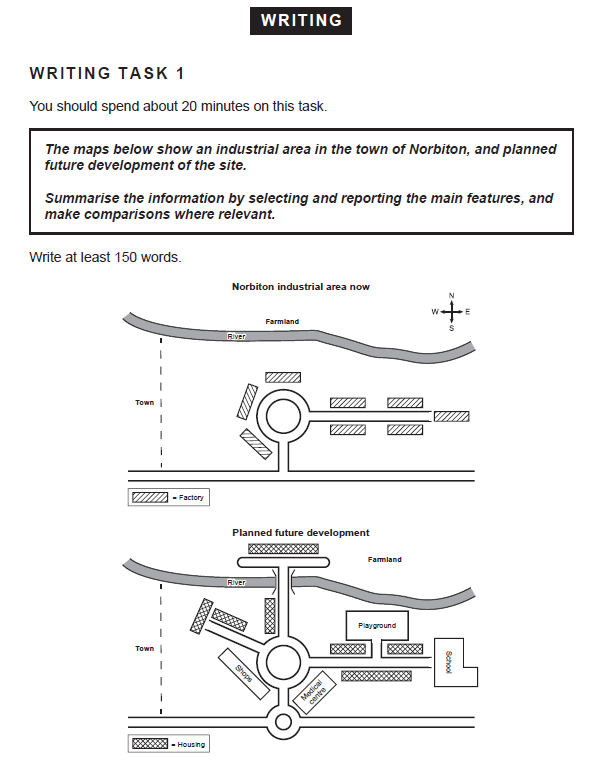
Study the prompt carefully before writing. Identify the key variables, time periods, and units.
Plan First — Always
⏱ Use the First 2–3 Minutes to Plan
Before typing a single word of your essay, spend 2–3 minutes identifying: the main trend(s), any notable exceptions or comparisons, and how you will group your detail paragraphs. Students who plan first consistently write more cohesive, Band 7+ responses. Jumping straight into writing is one of the most common mistakes test-takers make.
📋 The 4 Official Marking Criteria — Equal Weighting
Every Task 1 answer is marked on exactly four criteria, each worth 25% of your Task 1 score:
1. Task Achievement — Did you address the task? Is there a clear overview? Did you select and highlight key features?
2. Coherence and Cohesion — Is the essay logically organised? Does it progress clearly? Are cohesive devices used appropriately, without over-use?
3. Lexical Resource — Is vocabulary varied and precise? Are less common words used appropriately?
4. Grammatical Range and Accuracy — Are a variety of structures used? Are sentences mostly error-free?
The overview directly impacts Criterion 1. Vocabulary variety directly impacts Criterion 3. Sentence variety impacts Criterion 4. All four are equally important.
The 4-Paragraph Formula
Why Always 4 Paragraphs?
A clear 4-paragraph structure instantly signals to the examiner that you are organised and aware of what Task 1 requires. It separates general from specific, ensures you never mix raw data into your overview, and makes your essay easy to read and mark. Stick to this every single time.
1 Paragraph 1 — Introduction INTRO
Paraphrase the prompt. Replace "maps" with "diagrams/plans", "show" with "illustrate/depict/compare", "changes" with "developments/transformations". Include the location name and time period exactly as given.
Paraphrase: The two maps illustrate how the town of Riverside has changed between 1990 and the present day.
2 Paragraph 2 — Overview OVERVIEW ★
The Overview — Overall Scale of Change + Key Pattern
Start with Overall,. State: (1) the general scale of change (dramatic, significant, modest), (2) the dominant type of change (more urbanised, more developed, residential growth), (3) whether any major features remained unchanged. No specific locations here.
3 Paragraph 3 — Detail Group 1 DETAILS
Describe changes in one geographical area of the map, working logically (e.g. north and centre first). Use passive voice throughout and precise location language. Cover both what changed and, where relevant, what remained.
4 Paragraph 4 — Detail Group 2 DETAILS
Describe changes in the remaining geographical areas (e.g. south and east). End with any features that remained unchanged across both maps, using contrast language to integrate these observations naturally.
How to Build Your Sentences
Mix All Three Types Naturally
IELTS examiners reward grammatical range. The key word is natural. Only use linking words and complex structures when they genuinely improve clarity, never just to sound academic.
Passive Voice — The Core Grammar of Map Writing
In map tasks, the agent (builder, planner, council) is unknown and irrelevant. Always use passive voice to describe what happened to the place, not who did it. This is the single most important grammar rule for this task type.
[Feature] + [has/have been] + [past participle] (present perfect for recent changes)
Location Language — Your Compass Toolkit
Never write "on the left" or "at the top." Use compass directions and spatial prepositions. These are the expressions that separate a Band 6 from a Band 7+ map response.
Relative position: adjacent to, opposite, to the east of, alongside, next to, in the centre of
Movement: was relocated to, was moved to the south, was extended northwards
Replacement: was replaced by, was converted into, was transformed into
Change Verbs — Build Your Bank
Avoid repeating "built" and "changed." Rotate across this bank to demonstrate lexical range:
Removal: was demolished, was knocked down, was cleared, was removed, disappeared
Transformation: was converted into, was redeveloped as, was transformed into, was turned into
Expansion: was extended, was widened, was expanded, was enlarged
Permanence: remained, was retained, stayed, was unchanged, continued to occupy
Compound Sentence — Linking Two Changes in One Location
Complex Sentence — Noting What Remained Unchanged
Mentioning unchanged features is worth marks. Use contrast clauses to integrate them naturally.
Strategies Specific to This Question Type
🗺 Three Map Types — Different Tenses, Same Structure
Before writing a single word, identify which type of map you have. This determines your tenses entirely.
Type 1 — Past to Present (most common)
Use past simple passive throughout: "was built", "was demolished", "was replaced by".
Type 2 — Present to Future (plans/proposals)
Use future passive: "will be built", "is planned to be constructed", "is proposed to be demolished". Or: "it is planned that...", "it is proposed that..."
Type 3 — Single Map Description (rare)
Use present simple throughout: "is located", "stands to the north", "occupies the central area".
📍 Group Detail Paragraphs by Location, Not by Feature
The most logical and readable structure for map detail paragraphs is geographical grouping. Describe everything that changed in one area of the map in paragraph 3, then move to a different area in paragraph 4. Do not jump back and forth across the map.
⭐ Always Note What Did NOT Change
A Band 7+ map response always mentions at least one feature that remained unchanged. This shows the examiner you read the whole map carefully, not just the dramatic changes. Use: remained, was retained, was unchanged, continued to occupy, stayed in place.
🔢 No Data — So What Do You Include?
Like process diagrams, maps contain no numerical data. Your marks come entirely from: accurate location language, correct passive voice, variety of change verbs, clear logical organisation, and identifying both changes and constants. You cannot rely on numbers to fill words. Every sentence must describe a specific, clearly located spatial change.
Pro Tips That Separate Band 7 from Band 6
Proofread After Each Sentence
Don't wait until the end to proofread. Read each sentence immediately after writing it. If you spot errors at the end with only 30 seconds left, you will panic and that leads to more mistakes. Sentence-by-sentence proofreading keeps you calm and accurate.
Keep Your Overview Data-Free
The overview covers main trends, differences or stages. Never include specific numbers, percentages, or dates here. Save all raw data for your detail paragraphs. This is the single most common mistake that costs students marks on Task Achievement.
Group Details Logically
Don't just describe each category one by one. Group the highest with the lowest to show contrast, OR the highest with the second-highest if they're close together. Logical grouping shows analytical thinking, which is exactly what examiners reward.
Paraphrase — Don't Copy
Your introduction must paraphrase the task prompt using strong synonyms where appropriate. But don't force synonyms — only replace words when a genuinely better alternative exists. Forced vocabulary sounds unnatural and lowers your Lexical Resource score.
Do Not Over-Use Linking Words
The official IELTS criteria explicitly penalises both under-use and over-use of cohesive devices. Do not start every sentence with "Furthermore", "Moreover" or "In addition". Use linking words only when they add logical meaning. Two or three well-placed connectors per paragraph is enough. Forcing them into every sentence reads as mechanical, not fluent.
Aim for 175–200 Words
The official minimum is 150 words. Going under directly reduces your Task Achievement score. The sweet spot is 170–190 words. Going much over 200 wastes your 20 minutes and risks introducing errors. Every sentence must add genuine information value. Padding to reach a word count is penalised under Task Achievement.
Draw the Compass on Paper First
Before writing, draw a quick N/S/E/W compass on your question paper if one is not shown. Then label the key areas of the map in pencil. This prevents you from writing "on the left" or "at the top" and ensures every location reference in your essay is spatially accurate.
Use Approximation Language
Maps do not give exact measurements, so you should approximate spatial descriptions: approximately in the centre, roughly halfway along the northern edge, close to the eastern boundary. This sounds more natural and academic than trying to be impossibly precise about location.
Full Model Answer — Annotated
Model Answer with Paragraph Labels
The two maps illustrate how the town of Riverside developed between 1990 and the present day, showing changes to land use, infrastructure and facilities across the area.
Overall, the town underwent considerable transformation over the period, with agricultural and natural land largely replaced by residential, commercial and recreational development. The road network was significantly expanded, though the river and its bridge remained unchanged throughout.
In the northern part of the town, the farmland that previously occupied the area was cleared and replaced by a residential housing estate. To the east of the main road, a school was constructed adjacent to a small park, which was retained from the original layout. The main road itself was widened and extended northwards, improving access to the new residential zone.
In the southern section, the original woodland was largely cleared to make way for a leisure centre and car park. A footpath was built along the southern riverbank, linking the residential area to the town centre. The river and its bridge, which had occupied the south-eastern corner of the map in 1990, remained entirely unchanged, forming the only natural feature to survive the extensive redevelopment of the town.
✅ What Makes This a Band 7+ Response?
Notice how the introduction paraphrases without copying. The overview clearly states main trends or differences without any raw data, which is the key Band 7 Task Achievement requirement. The detail paragraphs group information logically with clear progression throughout, satisfying the Coherence and Cohesion criterion. The language moves naturally between simple, compound and complex sentences without over-using linking words, and vocabulary is varied without being forced.
Ready to Get Your Map Essay Scored by an IELTS Expert?
Get personalised feedback on your Task 1 essays from Ed — an IELTS expert who has helped hundreds of students reach Band 7 and above. Your band score is not fixed. Let's raise it together.
Start Your Journey at IELTSbyEd.com →Join hundreds of students who improved their band score with IELTSbyEd
