Line Chart (Dynamic) Masterclass
Track trends, crossover points, plateaus and recoveries across time — and describe them with the precision and vocabulary of a Band 7+ writer.
What Is a Line Chart Question?
A Line Chart plots data points connected by lines across time, making it ideal for showing trends, patterns, and changes. When multiple lines are present, your task is not only to describe each line individually, but to compare them, identify any points where they intersect or diverge, and describe the overall trajectory.
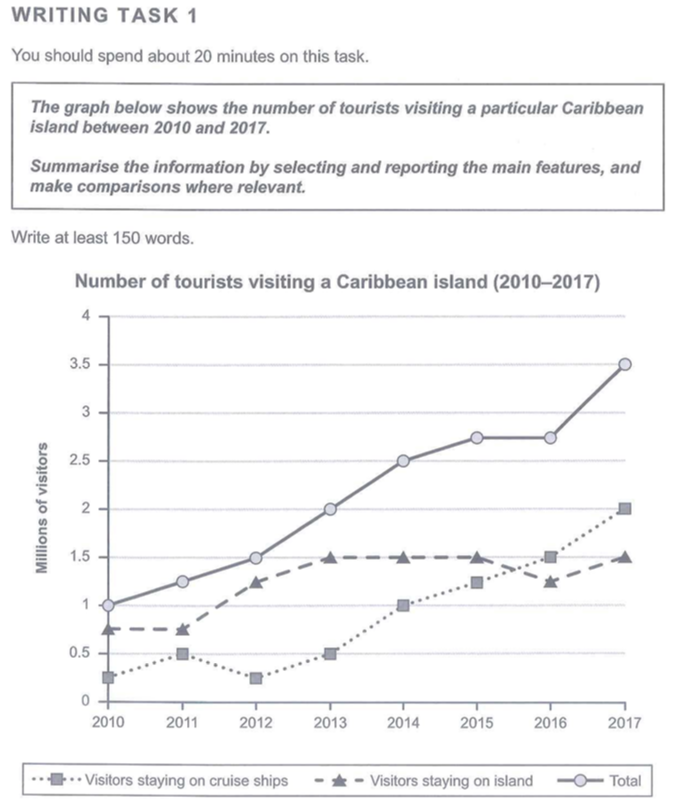
Study the prompt carefully before writing. Identify the key variables, time periods, and units.
Plan First — Always
⏱ Use the First 2–3 Minutes to Plan
Before typing a single word of your essay, spend 2–3 minutes identifying: the main trend(s), any notable exceptions or comparisons, and how you will group your detail paragraphs. Students who plan first consistently write more cohesive, Band 7+ responses. Jumping straight into writing is one of the most common mistakes test-takers make.
📋 The 4 Official Marking Criteria — Equal Weighting
Every Task 1 answer is marked on exactly four criteria, each worth 25% of your Task 1 score:
1. Task Achievement — Did you address the task? Is there a clear overview? Did you select and highlight key features?
2. Coherence and Cohesion — Is the essay logically organised? Does it progress clearly? Are cohesive devices used appropriately, without over-use?
3. Lexical Resource — Is vocabulary varied and precise? Are less common words used appropriately?
4. Grammatical Range and Accuracy — Are a variety of structures used? Are sentences mostly error-free?
The overview directly impacts Criterion 1. Vocabulary variety directly impacts Criterion 3. Sentence variety impacts Criterion 4. All four are equally important.
The 4-Paragraph Formula
Why Always 4 Paragraphs?
A clear 4-paragraph structure instantly signals to the examiner that you are organised and aware of what Task 1 requires. It separates general from specific, ensures you never mix raw data into your overview, and makes your essay easy to read and mark. Stick to this every single time.
1 Paragraph 1 — Introduction INTRO
Paraphrase: "graph" → "line graph/chart", "shows" → "illustrates", "number of tourists" → "number of visitors/tourist arrivals", "visiting" → "who visited/who travelled to". Keep the date range exact.
Paraphrase: The line chart illustrates the number of tourists who visited a Caribbean island from 2010 to 2017.
2 Paragraph 2 — Overview OVERVIEW ★
The Overview — Main Trend + Key Crossover
Start with Overall,. Identify: (1) the general upward trend in total visitors, (2) the crossover between cruise ship and island visitors. These are the two most important features of this chart. No data.
3 Paragraph 3 — Detail Group 1 DETAILS
Describe the total visitor trend from 2010 to 2017. Cover the overall rise, any plateaus (2015–2016), and the final acceleration to 3.5 million. Use a mix of simple and compound sentences.
4 Paragraph 4 — Detail Group 2 DETAILS
Describe the two individual lines — island visitors and cruise ship visitors — in the same paragraph. Cover the island visitors first (started higher, remained relatively stable), then cruise ship visitors (started lower, but overtook by 2017). Explicitly mention the crossover.
How to Build Your Sentences
Mix All Three Types Naturally
IELTS examiners reward grammatical range. The key word is natural. Only use linking words and complex structures when they genuinely improve clarity, never just to sound academic.
Simple Sentence — Clear Starting Points
Compound Sentence — Two Lines at the Same Point
Compare two categories at the same year or show them moving in opposite directions simultaneously.
Complex Sentence — Sequence of Change
Use participle phrases and subordinate clauses to describe a sequence of changes in one sentence.
The "Crossover" Observation — Essential for Multiple Lines
When two lines cross (as they do in this chart), you must identify when and describe the reversal of positions.
📐 Approximation Language — Essential for All Charts
Unless you can read an exact figure from the chart with certainty, always approximate. This is not imprecision. It is accuracy. Using approximation language correctly demonstrates maturity in academic English and is rewarded under Lexical Resource.
Slightly under a value → just under, just below, slightly below
Close to a round number → approximately, around, at about, roughly, nearly, close to
✅ "Ownership reached just under 70% in 2001."
✅ "Renting stood at approximately 78% at the start of the period."
✅ "Production amounted to at about 530 billion kWh."
❌ "Ownership reached 69.8% in 2001." [Never invent false precision]
Strategies Specific to This Question Type
📈 Line Charts = Focus on the Trajectory
For line charts, describe the shape of the line: Was it consistently rising? Did it plateau? Was there a dip followed by recovery? Use verbs that capture not just direction but also speed and consistency.
Essential Trajectory Vocabulary:
• Consistent rise: rose steadily, increased consistently, grew year on year
• Plateau: levelled off, remained stable, plateaued at
• Recovery: recovered, rebounded, bounced back
• Dip: dipped briefly, experienced a temporary decline, fell before recovering
🔀 Multiple Lines — The Crossover is Your Key Observation
When two lines swap positions during the period, this crossover is one of the most important features to identify and describe. In this task, cruise ship visitors started well below island visitors in 2010 but overtook them by 2017. This is an essential observation for Task Achievement.
🎯 Group Logically: Total + Breakdown
When a chart shows a "total" line and individual component lines, describe the total in your first detail paragraph, then break down the individual components in your second. This is a natural and logical grouping strategy.
Pro Tips That Separate Band 7 from Band 6
Proofread After Each Sentence
Don't wait until the end to proofread. Read each sentence immediately after writing it. If you spot errors at the end with only 30 seconds left, you will panic and that leads to more mistakes. Sentence-by-sentence proofreading keeps you calm and accurate.
Keep Your Overview Data-Free
The overview covers main trends, differences or stages. Never include specific numbers, percentages, or dates here. Save all raw data for your detail paragraphs. This is the single most common mistake that costs students marks on Task Achievement.
Group Details Logically
Don't just describe each category one by one. Group the highest with the lowest to show contrast, OR the highest with the second-highest if they're close together. Logical grouping shows analytical thinking, which is exactly what examiners reward.
Paraphrase — Don't Copy
Your introduction must paraphrase the task prompt using strong synonyms where appropriate. But don't force synonyms — only replace words when a genuinely better alternative exists. Forced vocabulary sounds unnatural and lowers your Lexical Resource score.
Do Not Over-Use Linking Words
The official IELTS criteria explicitly penalises both under-use and over-use of cohesive devices. Do not start every sentence with "Furthermore", "Moreover" or "In addition". Use linking words only when they add logical meaning. Two or three well-placed connectors per paragraph is enough. Forcing them into every sentence reads as mechanical, not fluent.
Aim for 175–200 Words
The official minimum is 150 words. Going under directly reduces your Task Achievement score. The sweet spot is 170–190 words. Going much over 200 wastes your 20 minutes and risks introducing errors. Every sentence must add genuine information value. Padding to reach a word count is penalised under Task Achievement.
Use Approximation Language — Always
Saying "approximately 60 billion" or "at about 50%" is not a weakness — it is a sign of academic writing maturity. Use: just above, just under, approximately, around, at about, roughly, nearly, close to. Reserve exact figures only for the clearest data points. Approximating correctly is actively rewarded by IELTS examiners under Lexical Resource.
Approximate, Don't Invent
Line charts rarely give exact figures. Use approximation language: approximately, around, roughly, just under/over, nearly. Never invent a precise figure you cannot read from the graph. Approximating correctly is actually rewarded.
Full Model Answer — Annotated
Model Answer with Paragraph Labels
The line chart illustrates the number of tourists who visited a Caribbean island from 2010 to 2017.
Overall, the period was characterised by an upward trend in visitor numbers. Notably, the figures for those staying on cruise ships overtook the number of visitors choosing onshore island accommodation by the end of the period.
At the start of the period, the total number of visitors stood at one million. This figure then experienced a consistent year-on-year rise, reaching approximately 2.75 million in 2015, followed by a plateau that lasted until 2016. The upward trend resumed thereafter, with visitor numbers climbing to around 3.5 million by the end of the period in 2017.
Turning first to island-based visitors, the figure stood at approximately one million in 2010. It then rose steadily, reaching around 1.5 million by 2013, a level which was maintained until 2015. A subsequent decline brought the number down to roughly 1.25 million in 2016, before a recovery saw it climb back to just under 1.5 million in 2017. Meanwhile, the number of visitors opting for cruise ships began at about 0.25 million, considerably below island visitors. After a temporary dip in 2012, they grew consistently to approximately 2 million by 2017, overtaking island accommodation in the final year.
✅ What Makes This a Band 7+ Response?
Notice how the introduction paraphrases without copying. The overview clearly states main trends or differences without any raw data, which is the key Band 7 Task Achievement requirement. The detail paragraphs group information logically with clear progression throughout, satisfying the Coherence and Cohesion criterion. The language moves naturally between simple, compound and complex sentences without over-using linking words, and vocabulary is varied without being forced.
Want Your Line Chart Essay Reviewed by an IELTS Expert?
Get personalised feedback on your Task 1 essays from Ed — an IELTS expert who has helped hundreds of students reach Band 7 and above. Your band score is not fixed. Let's raise it together.
Start Your Journey at IELTSbyEd.com →Join hundreds of students who improved their band score with IELTSbyEd
